Interviews and press conferences
Prime Minister Nikol Pashinyan's interview with Public Television
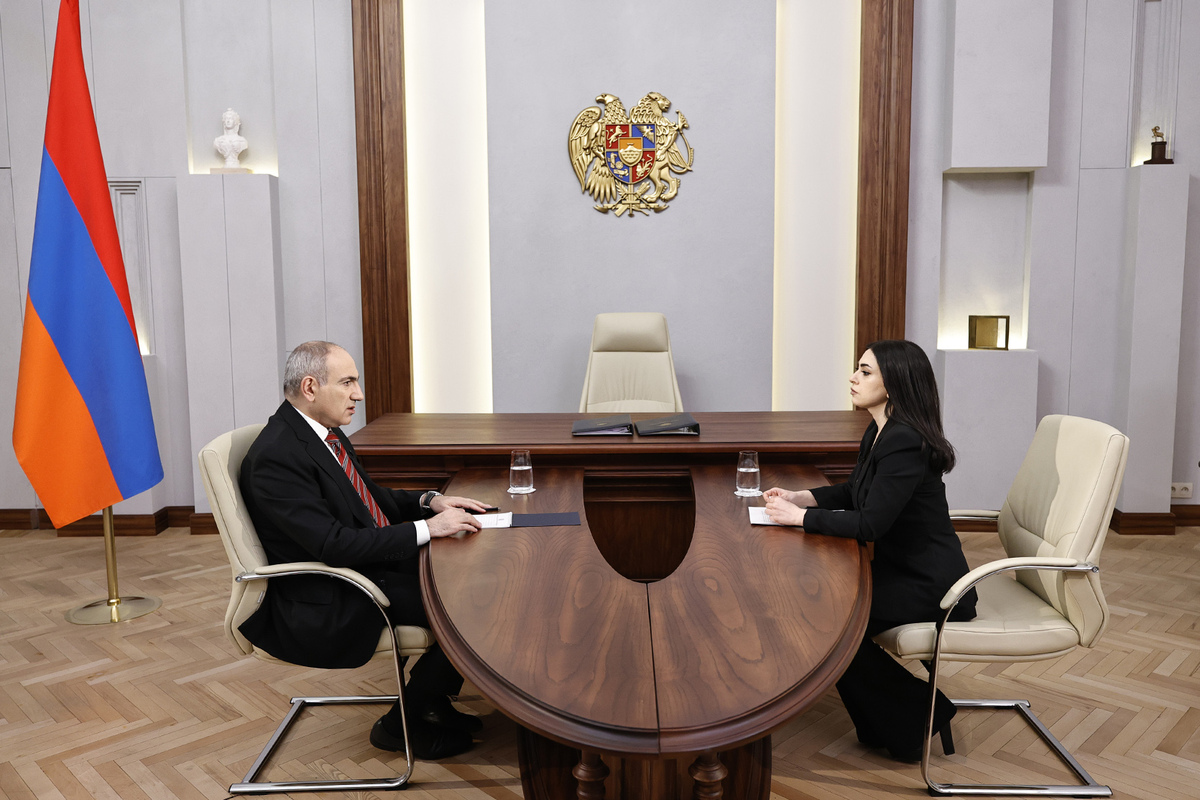
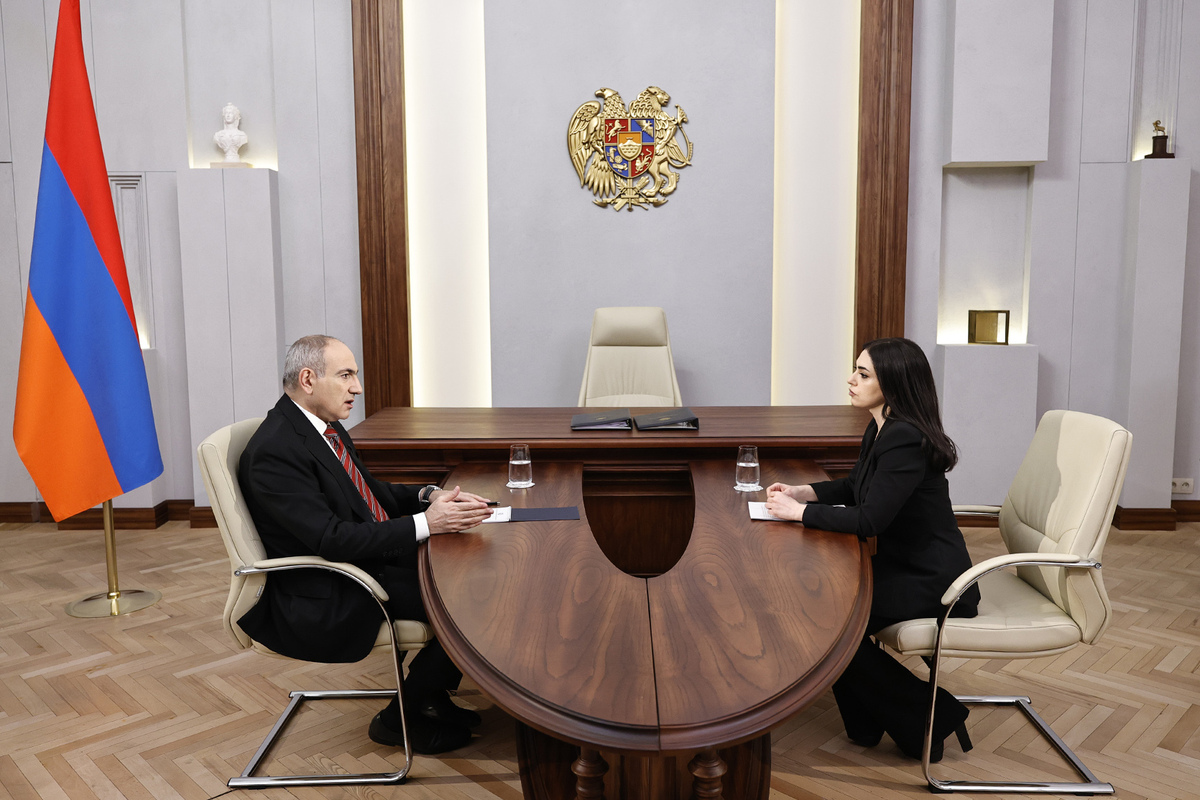


Prime Minister Nikol Pashinyan gave an interview to Public Television. Below is the full transcript of the interview with Tatev Danielyan.
Public TV - Good evening, today my interlocutor is the Prime Minister of the Republic of Armenia Nikol Pashinyan.
Good evening, Mr. Prime Minister, thank you for this opportunity. Let's start with Vance's visit. It is a historic visit, because he is the highest-ranking US official to visit Armenia ever, and the agenda was quite full, from nuclear energy cooperation for peaceful purposes to semiconductors, chips, drones worth $11 million, an investment of five and four billion USD under the TRIPP fund, in two stages, and I think the most important thing was that Vance mentioned that he is so confident in Armenia that they are not only making investments, but also exporting technologies here. If we were to summarize this visit, what did we expect and what did we get and what prospects does it open for further cooperation?
Prime Minister Nikol Pashinyan - In practical terms, we got what we expected, but it should also be noted that the atmosphere of the visit turned out to be much more pleasant, much more positive than we even expected. I am very happy to note that it was very positively perceived among our society. And this is perhaps an important and very expressive image of a balanced and balancing foreign policy, the results of which we see.
And of course, the economic context of the visit is very important, because the visit of the Vice President of the United States, and especially the visit of such a bright political figure as JD Vance, naturally puts Armenia in the spotlight of the world. And it is very important that the attention of the investment environment of the United States is additionally drawn to the investment opportunities that have opened and are opening in Armenia.
I also know that there are discussions related to the numbers. It is very important to record that the Vice President of the United States, by publishing those big numbers, shows the great political will of the United States to support investments in Armenia. Those big numbers must be specified and turned into specific projects, specific addresses, specific locations, and, of course, the directions, which you have already mentioned. For the first time, we are implementing and will implement cooperation with the United States in the defense sector, but it is very important to record that all of these are actually the results of the peace agenda. And you know, it's just amazing, I was also talking to the Vice President in retrospect, I remember our meeting a year ago, we met for the first time on February 7, 2025, I even said during our conversation and lunch, I remember what the White House was like at that time, with the old pictures taken down, the new pictures not yet hung, with furniture being moved around, boxes of personal belongings coming in and out, etc., and it was among those boxes that it was possible to organize that meeting, which was of great importance. And I specifically emphasized that my respect for the Vice President doubled, tripled, that by the time I arrived in Yerevan from Washington, the United States Embassy had already notified us that the Vice President of the United States had reported to the President of the United States on the results of the visit and that the necessary instructions had been given, and that surprised me greatly. And here we are seeing the results of that today.
Public TV - Mr. Prime Minister, you also said that you have seen discussions about the numbers, the opponents say, what billions are we talking about, will the rails, the railway be made of gold? Where are so many investments needed and why couldn't we do it with our own resources?
Prime Minister Nikol Pashinyan - First, on the one hand, about our resources and not our resources. Usually the opposition criticizes us that there is a shortage of foreign direct investments or why they are not growing at the necessary rate, now, in fact, there will be large cash inflows to Armenia, and any country always wants money to come from abroad and double, triple, quadruple on the spot. But it is also very important to note that one unit of investment in certain areas brings two more units, sometimes three units, sometimes four units of investment, and, in fact, we are talking about the formation of a new investment ecosystem, because the railway is a railway, but it is not only the rail, it is also the service, other services, highly modern equipment, etc., and so on, not to mention the service of the flow of passengers, goods, services. Moreover, look, we are talking, we are focused on the railway, and that is good, that is right, but we are talking about new power lines, we are talking about new pipelines, we are talking about cables, which are very important. Let's connect these cables with the new supercomputer center being built in Hrazdan, which will provide regional and international services in the field of artificial intelligence, combine all this with tourist flows, etc., and we will see, that is, here the investment brings investment. Generally something like this is said about the technology sector, that one job created in the technology sector creates three or four, sometimes they say five jobs in other sectors, and we are dealing with the same phenomenon, the same effect.
Public TV - One more question on this issue, Mr. Prime Minister, and then let's move on. Again the opponents say that 26% is nothing, it doesn't give Armenia anything economically, the United States has no economic interest either, it comes to the region to have influence on Iran. I don't know, if it were, say, 36-64%, there wouldn't be the same criticisms, how was that ratio determined? And secondly, about our and the United States' economic interest, please.
Prime Minister Nikol Pashinyan - You know, first of all, I want to record, and we will see it in the process, yesterday we already saw that, of course, what happened in Washington on August 8 was first and foremost a political declaration, a political meeting, political negotiations, but the further we move away from August 8 and the more political goals are realized, the more a transformation towards the economy takes place. Diverging from the topic a little, I say in the negotiations too, we see that the economy is overtaking politics in the Armenia-Azerbaijan agenda, the same is true here. And as much as the political declaration and statement itself draws economic attention, and when the economy begins to overtake political statements, when the specific weight of economic statements begins to be more than the specific weight of political statements, it means that the political statement has been justified, has achieved its goal, that is, it is being implemented, and this is what we are talking about. And if you noticed, yesterday most of the statements of the Vice President of the United States were already economic rather than political. This means that the statement of August 8 was a success. We did not discuss at all, we did not talk about the border situation, we did not talk about regional tensions. What does that mean? It means that there is no such issue on the agenda. Of course, there are issues related to the conflict or post-conflict situation on the agenda, which, naturally, were discussed, and I have said that all issues are discussed, in all cases these issues are discussed and, in particular, the issue of our compatriots in prison, but I have said before, my experience shows that on this issue, the more quietly we act, the more...
Public TV - Do you mean you discussed it with Vance?
Prime Minister Nikol Pashinyan - Yes, of course, including with Vance, because you know that this issue was present in the Armenia-United States discussions on August 8, and it was present in subsequent discussions.
Public TV - Mr. Prime Minister, many oppositionists sent letters to Vance, and they also demonstrated at that time when he was in the presidential palace, so I mean, have you spoken to him and has Vance expressed willingness to have a discussion on that issue in Azerbaijan?
Prime Minister Nikol Pashinyan - I ask you to expect as few details as possible from me on that issue, but the issue was on the agenda and the issue was discussed on the agenda. And let me say more, there is no exaggeration - in practice, there is no such negotiation, directly or indirectly relevant, where we do not touch on that topic, simply there is not. I say again, relevant, because there may be formats where there is no direct or indirect relevance at all. In all relevant formats, we have regularly raised that issue, we are raising it, and we will be consistent in resolving that issue.
Public TV - Returning to the TRIPP, the main uncertainty here that exists and gives rise to criticism is the principle of reciprocity of the so-called Front Office and Back Office. If I briefly introduce, a Front Office is a private company providing certain border services, with employees who are not citizens of the Republic of Armenia, but subject to the legislation of the Republic of Armenia. The Back Office is already our state services, with our citizens, naturally, under our legislation. Now the question arises, we still do not understand whether it will work the same way in Azerbaijan, will there be a Back Office and a Front Office, and will our citizens also meet not with Azerbaijani citizens, but with citizens of a third country?
Prime Minister Nikol Pashinyan - In order to understand the question correctly, let me again connect it with the answer to the previous question: we must perceive TRIPP as an investment program, because TRIPP was a political statement on August 8, now TRIPP has turned into an investment program, where the United States will lead this investment activity.
By the way, I forgot to touch on the issue related to the percents, I'll mention it so I don't forget, because it's a very important issue. And we, including the Front Office, Back Office, must perceive and that's the case in reality, the investor's desire and the investor's aspiration is to provide the highest quality and most attractive services possible, so that as many people as possible can use it, because we say people in the Front Office, Back Office, but there may not be people at all in the Front Office, but there may be artificial intelligence, but there may be state-of-the-art equipment, and the main function of that Front Office may be to service that equipment, etc. And by the way, I want to say, it's very important to have such modules, for example, we see in many developed and developing countries, at airports in the United Arab Emirates, Qatar, European countries, etc., and we will work to have such services, already with our different logic, at all our border checkpoints, at our airport. Now we are introducing a biometric passport system and our goal is to have citizens of the Republic of Armenia and citizens of other countries with biometric passports go straight to the plane without stops and get off in the same way.
Public TV - Mr. Prime Minister, it is not bad, but very good, but you must agree that this issue also has a political component, and that is why I am asking: what will happen on the part of Azerbaijan?
Prime Minister Nikol Pashinyan - That is why I was saying that TRIPP is an investment program that is being implemented in the Republic of Armenia. There is no TRIPP in Azerbaijan, and therefore, I cannot say what will happen in Azerbaijan. The point is that in both countries, border crossings, etc., will operate within the framework of the sovereignty, territorial integrity, and jurisdiction of the countries, and there will be access to transport communication channels on the basis of reciprocity.
As for the percentages, first of all, I want to emphasize again that, according to the agreement, after 50 years, the percentage ratio will change and the Republic of Armenia will already have 49%. Why is that so? Because the calculation shows that people are making investments, we are talking about billions of investments, these investments must ensure returns. I am referring to this economic interest because it would be illogical if we told the United States or anyone else, you know what, let's invest two billion dollars, whatever happens, it doesn't matter whether you bring that money back or not. Now the problem is that any investor, in all investment projects, including in Armenia, when he makes an investment, wants to have certain guarantees that he will bring that money back, with a certain profit, because otherwise, why would he invest? Instead, he would take it to the bank, put it in interest and get that money back. And this is related to this.
The second nuance, at first, including us, we were thinking, we were saying, but 99 years, 50 years, we had some discomfort with these numbers, including within the team. And then, at some point, we recorded, we said, but let's look at this issue from a different perspective. The United States of America is implementing an investment program in the Republic of Armenia for 99 years, at least for 99 years. In other words, the world's number one superpower is saying that the Republic of Armenia will exist for 99 years, as an independent, sovereign state, it will be peaceful and there will be a normal investment environment there.
Sorry, I will make a statement that will sound sharp and I do not exclude that it will be perceived with criticism, but, for example, I am looking for and I do not see any period in our previous history where we had a 99-year perspective in front of us, we had a 99-year plan and we drew up, designed that 99-year plan with the world's number one superpower. I want us to truly appreciate this moment, and this communicates and corresponds with the agenda for the perpetuity of our statehood that we adopted back in 2018.
Public TV - Let's move on to other topics, Mr. Prime Minister, earlier this month you and the President of Azerbaijan were in Abu Dhabi, you received the Zayed Award for Human Fraternity, apart from raising Armenia's visibility, so to speak, can this have any significance, any impact on establishing peace?
Prime Minister Nikol Pashinyan - Definitely, because I said in my speech there, imagine the leaders of two countries going and receiving such a prestigious award in a prestigious environment, an award that was founded by two very influential leaders of the Islamic and Christian worlds, they receive an award for establishing peace, what does that mean? It means reaffirming the policy and strategy of peace.
Public TV - I am asking this, Mr. Prime Minister, because both of you were speaking from the stage about the advantages of the established peace, it was a very good environment there, with a good mood, you were saying that peace is useful, and what came next? This was followed by the verdicts in the Baku court against the military-political leadership of Karabakh, sentencing them to life imprisonment. Now a kind of logical rupture arises here: where is the peace, fraternity and humanity, when our compatriots are sentenced to life imprisonment in Baku prisons?
And so, as a sub-question, after these verdicts come into force, is it possible, is there a chance, that they can still be returned to Armenia?
Prime Minister Nikol Pashinyan - First of all, let me say that these decisions are, of course, very painful and difficult for me personally, and politically, but on the other hand, we must understand that the conflict has inertia, and that inertia cannot be stopped by using a single lever. Naturally, I have already said that this topic is always in the center of our attention, and a natural question will arise: what is our idea of solving this issue? Our idea is peace again, because peace is the environment in which it is possible to solve this problem. In an environment of conflict, this problem is insoluble.
Let me give you an example, I especially want to give this example: last month, four people, our compatriots, returned. I want to say that in the concrete case of Vagif Khachatryan, I want to assure you unequivocally that if there were no peace-enhancing environment, he would not have returned, he would not have returned to Armenia, at least he would not have returned now and at least he would not have returned in the foreseeable future. And I say this knowing a number of details in terms of the environment surrounding him. And again, peace is the environment, you see, if peace is not developed, is not institutionalized, the atmosphere of peace is not developed, the solution to that issue is excluded. Peace is the environment where the solution to that issue will become possible, and I say again, the example of Vagif Khachatryan is a very concrete example for me, which shows that this is the direction and the path to solving the problem.
By the way, I want to tell you something, you are aware that there were problems related to Vagif Khachatryan's health, there were issues, etc., and emotionally it was very difficult for us to not react, to make no statements, to not appeal to various international instances, etc., but if we had gone that way, I guarantee that Vagif Khachatryan would not have returned. I understand our emotions, I understand that in many cases, yes, they criticize us, they say that we do not react, what is the purpose of this instance, that instance... Although, let me say, in individual directions I also know that there are legal processes, including in international instances, but specific examples lead us to the conviction that if we focus on the peace agenda and form certain working processes in this environment and atmosphere, it leads to success.
In this context, I want to share my impressions of our meeting in Abu Dhabi, and when we gather as a delegation after the meeting and discuss, as is usually the case, it was very interesting that we all noted that we have at least begun to touch the line beyond which peace is irreversible. We have come very close, I repeat, I will not try to be more ambitious, but we have touched, we are already touching the line beyond which peace is irreversible.
Public TV - Now, beyond that tangible line, in Abu Dhabi, there was also a meeting of delegations between the Armenian and Azerbaijani sides, led by you and Aliyev. Were there any issues discussed here that still concern the Armenian society, because the press release was very brief, for example, the continuation of the demarcation, if we say TRIPP is feasible, we are implementing it now, we urgently need demarcation in Syunik, for example, the withdrawal of Azerbaijani troops from the occupied territories, for example, the signing of the initialed peace treaty, at least approximate dates for signing, if possible, elaborate a little further on these issues.
Prime Minister Nikol Pashinyan - As far as it will be correct, I say again, I have no secrets from our people and society, but there are diplomatic nuances that I must keep, naturally, all possible issues were discussed. First, I want to refer to the issue related to the occupied territories once and for all. We have said and we already have a document with the highest legal force in both countries. These issues will be resolved in the process of demarcation, because I say again, this is a very clear record, and we have done this a long time ago, there will be no disruption of peace over this issue, we will consistently follow the path of demarcation and, based on the 1991 Alma-Ata Declaration, we will accurately define the sovereign territories of Azerbaijan and Armenia.
There is an additional nuance in the implementation of demarcation and opening communications in the sidelines of the TRIPP, because the border is long and demarcation will naturally take quite a long time. By the way, I would like to say that the demarcation commissions also work remotely, because they develop various documents, draft protocols, that is, daily work is underway, in fact, demarcation is a very, very detailed and complex process, and it continues and will continue.
Regarding communications, we have an understanding that in this case we need to organize the demarcation process a little differently. In those sections where a railway, pipeline, power line should pass, in that section, let's say, it needs a 500-meter-wide area, we must first demarcate at least one and a half kilometers, so that none of the parties has any doubts, specify the border with millimeter accuracy, and only then take actions related to communications.
Naturally, we also discussed issues related to the signing of the Peace Agreement, issues related to the further institutionalization of peace.
Public TV - There are discussions in the political field that before the parliamentary elections of Armenia, it might be signed and the border with Turkey might open. Do you have such a feeling?
Prime Minister Nikol Pashinyan - I have such an agenda, I won’t say anything about the feeling at the moment, because you know what, the signing in December, the signing in January, in October, in April of last year was in the agenda, because we had already completed the negotiations in March, so we will work, we will work. It was very important, again in Abu Dhabi, and it is one of the pleasant moments, a very significant economic content appeared in our conversations. We were discussing what economic projects there are that are of mutual interest, and by the way, we are talking about bilateral trade. A very important point, which I think this is the most appropriate format to talk about, because I was thinking of inviting businessmen, etc., to record this topic, but I think this is the most appropriate format. We all know that the railway connection to Armenia through Azerbaijan is operational and operates without hindrance, but it is very important to record that the railway connection from Armenia to the outside world through the territory of Azerbaijan is also open.
And I have the impression that our business has not yet digested this news, because I think that our business entities should already think about exporting.
Public TV - Mr. Prime Minister, when you said it was direct and unhindered, do you mean there was a direct border crossing from Azerbaijan to Armenia?
Prime Minister Nikol Pashinyan - No, the train comes through Georgia...
Public TV - Yes, now, if trade is good, if we are talking about established peace, isn't the possibility of a direct border crossing being discussed?
Prime Minister Nikol Pashinyan - Well, but I say it again, the railway must be built, right? We don't have a railway at the moment to make a direct border crossing.
Public TV - By road.
Prime Minister Nikol Pashinyan - It is also being discussed by road, those discussions exist, they will happen. You know that we have also proposed route from Turkey to Azerbaijan and from Azerbaijan to Turkey, but I will finish my idea. Now in Abu Dhabi it was once again recorded that exports can be carried out by train from Armenia to Georgia, as long as this railway is operational, from Georgia to Azerbaijan and further to Russia, Central Asia, China. And I want this to be recorded. We also talked there that perhaps there is a bit of pessimism among our business, etc., and the representatives of Azerbaijan assured that this route will not be closed and that this route is open and reaffirmed that Armenian business, economic entities can use the Azerbaijani railway for exports.
This, I think, is a very significant and historical point, because for the first time since the 90s, last year a train entered the Republic of Armenia through the territory of Azerbaijan, for now through the territory of Georgia, of course, and in the future after the implementation of the railway projects, the highways will also be opened. I think there will be such developments in the near future, now we are working on the details.
Public TV - It is clear. For the continuity of TRIPP and for the unblocking of the channels, transport routes, it is also necessary that the sections of the railway currently under the management of the Russian company be renovated. Armenia has applied, Russia has said that they are discussing it, will give answer. Now what alternative solution do we have, Mr. Prime Minister, if Russia, for example, refuses to do this, or worse, does not refuse, but simply continuously delays?
Prime Minister Nikol Pashinyan – First of all, of course, we have appealed to our Russian partners, and in political terms, it seems that we have a positive response. But there is a very important practical issue here, thank you for the question and it is appropriate for me to talk about it. Look, what problem do we have in the same regional communications? It is obvious that the railway will enter Meghri from Zangelan, from Meghri to Nakhchivan, that is, Ordubad, etc. In the international context, it is very important how this railway will continue. Now there are two competing options. You know that Turkey and Azerbaijan have announced a project to build a new railway from Kars to Diliju, that is, from Kars to Nakhchivan. And, naturally, we expect the international route to pass along the Yeraskh-Akhurik line, where there is an operating railway, because in the Yeraskh section there are only a few kilometers of railway tracks missing, and in Akhurik even shorter, which is already next to the Turkish border. And now we need to focus on our competitive advantages. Here we see that in the international context, the fact that this section of the railway is under Russian control is used to present the Kars-Diliju route as more attractive, and this is a problem for us, because it turns out that we are losing our competitive advantages, when we have a ready-made railway... Of course, to bring this railway into line with modern requirements, an additional investment of several hundred million dollars will be required. I want it to be clear: restoring only small, missing sections is not a particularly big problem, neither financially nor technically, but we must definitely ensure the rail speed of this railway.
Now, look, we have great respect and love for our Russian partners, but the fact is that due to the tense international context, due to the fact that our railway, which is our property, this is very important, is under the management of Russian Railways, we feel that we are losing our competitive advantage here. And here we need to think about what to do, because this is not a matter of one year, two years, three years, four years.
Public TV – What are you going to do, this is my question?
Prime Minister Nikol Pashinyan – We must find a solution, and we must find that solution in a friendly, fraternal logic. First of all, today we, unfortunately, see and information is constantly circulating in different places the fact that it is presented as a Russian route, and for that reason, from scratch, several billion dollars are being invested to build the Kars-Diliju railway. And, to be honest, I have asked this question directly to our partners, both to the President of Turkey and to the President of Azerbaijan, not in such detail. I have said that we are moving towards a settlement, we are moving towards peace, that is, we are already in conditions of peace, and that railway passes through Armenia, why are you spending several billion dollars to create something that already exists? Of course, they responded to that question with diplomatic silence, but now, seeing a lot of discussions, the international press, the analyses of the international expert community, we understand that this is the main problem, and we need to understand what solutions we have, because I say again, we are talking about Armenia's long-term strategic interests, and all our friendly countries should be interested in ensuring that our interests are served and not the other way around, that our interests find themselves in a deadlock.
Public TV – Mr. Prime Minister, Russian Deputy Prime Minister Overchuk said in a statement that the signals coming from Brussels indicate that the European Union is turning from an economic unit into a military-political structure and was asking whether Armenia is ready to become part of a union that, in his words, is aggressive towards Russia and he was saying that sooner or later Armenians will have to ask themselves this question.
Prime Minister Nikol Pashinyan – I want to share with you and the public our strategic understanding of our relations with Russia. We share the following idea everywhere, with all our partners, that harming Russia and Russia’s interests has not been, is not and will not be on our agenda. That is ruled out. No one will be able, even if they try, but there have been no attempts so far, no one will be able to drag us into the logic of acting against Russia. And we also tell our Russian partners, we say, you know, we will not fight with you, we will not wrangle with you, we will not get into a war of words with you, because we value the relationship that we have. Yes, at the interstate level, but the personal level is also no less important in this context: I have very direct and warm relations with the President of the Russian Federation Vladimir Putin, and I have very warm and direct relations with the Prime Minister of the Russian Federation Mikhail Mishustin. This is our strategy, we will not act against Russia, but we will always act in the interests of the Republic of Armenia. And we ask our Russian partners whether they have any criticism of this logic. We say, we will never act against Russia, but we will always act in accordance with the interests of the Republic of Armenia, and this will be our strategy. Here we understand that there may be certain intersections, but we cannot say, you know what, we are acting against the interests of Armenia and for the interests of Russia, or any other country, that would be illogical, no country would act like this. Yes, there may be certain problems and disagreements, but I want to give you the example of August 8, because after August 8, it is clear that there were certain questions among our partners in the Russian Federation, and I answered those questions with pleasure. Saying with pleasure I mean that we are always open to conversation.
Public TV – So there were concerns?
Prime Minister Nikol Pashinyan – Yes, of course, naturally, it was expressed in the expert circle, in the press. I drew the attention of our Russian colleagues to a simple fact. On August 8, 2025, we signed in Washington the content that we had previously, over the past five years, offered to the Russian Federation. Of course, there was no Trump route there, but we wanted five words, just five words. Those words were: territorial integrity, sovereignty, jurisdiction, reciprocity, inviolability of borders. We said, put these five words on paper, and I am ready to sign that paper at any time. And there is no exaggeration in what I said. And this is a very specific example that we have never acted against Russia and will not act. But we, of course, excuse me, cannot act against Armenia and we must always act in accordance with the interests of Armenia. And we will not fight with Russia, we will not fight and there is no need. It is clear, you know, that there are always tensions and discussions on the agendas. We will always discuss, but we will not fight with Russia, we will not create problems with Russia, but we will pursue our interests.
Public TV – That's clear, let’s touch on a few domestic political issues, Mr. Prime Minister, it is clear from your public statements that you have not abandoned the agenda of removing Garegin II from the throne of Catholicos. What concrete steps are being taken now and what is the council that was created for the reform of the church busy with?
Prime Minister Nikol Pashinyan – As planned, our main task is, first of all, to make the agenda more understandable to the public, because, including perhaps because of our and sometimes my emotional manifestations, perhaps the public sees more noise than the essence of the issue. And for us, the essence of the issue is very clear. First, the cornerstone issue is the following: first, the Church cannot be a state within a state. And in general, I have said that there cannot be a state within the state. And in the previous period, unfortunately, we have seen constant manifestations that the church is not only trying to position itself, in fact, without declaring it, as a state within the state, but as in a foreign state within the state. We say that this should not happen. The second issue is that the church should not engage in politics. That is, the church should not be a participant in domestic political life. Look, when Ktrich Nersisyan was talking about the government, my resignation... I am not the issue here, do you understand, these are political processes. Okay, they said it one, two, three times, we said, okay, we must be tolerant, but later on other bishops already started making political statements. And what happened? It happened so that Bagrat Galstanyan started a political movement after the consultations in the Mother See and as a result of those consultations. What happened is also very important, that political process took place in a democratic country and environment and died out, that is, it was rejected by the public. All this cannot remain without consequences, because we are talking about the sovereignty and security of our state.
But to implement all this, to solve these problems, we need a church reform agenda, which is about that there should be mechanisms for the good conduct of high-ranking church representatives, financial transparency, and accountability, because today we have information that is in the process of being verified, according to which shadow money is entering the Republic of Armenia, including in the formats of the Armenian Apostolic Holy Church, to be used for political purposes in Armenia.
Public TV – What do your opponents say? They say that if a person is a clergyman, it does not mean that he should not have political views. The facts you mentioned are for initiating criminal cases. Initiate criminal cases, punish those clergymen who violate the law of the Republic of Armenia, but do not start a campaign against those clergymen who have a different opinion from you and demand your resignation.
Prime Minister Nikol Pashinyan – Not only clergy, but everyone has the right to have political views. It is one thing to have political views, it is another thing to have such means and forms of expressing political views. You know what, using the altar during sermons to preach politics, sorry, that is sacrilege, because the liturgy is about Jesus Christ and the values he professes. Since 2020, political, I would say radical texts have been heard during sermons in almost all churches in Armenia. I hope my comparison sounds correct, but also, you know that in the world, in many countries, there are also manifestations of Islamic extremism, against which the world community, the international community, has to fight. Look, you say, let criminal cases be filed, criminal cases are being filed, they say, how, do you file a criminal case against clergy, how can a criminal case be filed against a clergyman? No one says how a cleric could plan to cut off the electricity supply to a part of the Armenian capital or the republic, to sabotage, to stop traffic, to talk about shooting people under the walls.
Public TV – Those cases are in the court, Mr. Prime Minister, I am not talking about that.
Prime Minister Nikol Pashinyan – Very good, but there is a specific case and there is an environment where these cases are created. In other words, what is our task? To allow these manifestations of extremism to increase, the plan to become feasible, the threats of executions to become real executions, so that later they say, where was the state, where was the state looking, where was the National Security Service looking, where was the Government looking, etc.
Public TV – Now coming to the beginning, you say, I want an appropriate environment to be created, the public to be informed, how do you imagine, how much time will be needed for this and should we expect specific actions or not?
Prime Minister Nikol Pashinyan – The point at which this should happen is, after all, Armenia is a democratic state and nothing can happen without the support of the public. I am often told that I have not stopped being revolutionary, whatever happens I refer to the public. It is about legitimacy, for me legitimacy is an absolute value, and physically, let’s say, implementing processes, especially in the status of Prime Minister, is perhaps not that difficult. Especially in conditions when something unprecedented happens, the bells of the Mother See are ringing, inviting people, but no one responds to it. This speaks of the deep spiritual crisis caused by the leadership of the Armenian Apostolic Holy Church. Let me say something else, we often talk about the fact that we must have a value-based society, a value-based community, where values, moral norms, ultimately have weight and that weight will gradually increase. I say it is impossible to have a value-based society when the epicenter of our values, our holiest site, the Mother See of Holy Etchmiadzin, is contaminated. These are complex issues, this, by the way, is a very serious, delicate and difficult issue, and I say again: no matter how long I will go this way, but on that path I will never deviate from legitimacy. I say again: I consider myself a person with spiritual values and a spiritual life, and I cannot separate my identity as a follower of the Armenian Apostolic Church, as a faithful follower, from myself and put it four meters away. And this is the answer to the question. I am the Prime Minister of the Republic of Armenia, and I am a faithful follower of the Armenian Apostolic Holy Church, I cannot be divided into two parts.
Public TV – One of the opposition forces, Mr. Prime Minister, declares that in these conditions of poverty, 21% poverty, the Prime Minister should not only not receive a bonus, but also receive a salary of one dram, and some ministers, they say, will be remunerated with private funds after they come to power. Now, first of all, why don't you work for one dram as prime minister, and how do you feel about this concept of governance in general?
Prime Minister Nikol Pashinyan – When I work as a prime minister for one dram and you ask me in an interview where I got this suit, what will I answer?
Public TV – You will say that you were supported with private funds.
Prime Minister Nikol Pashinyan – That is corruption. That is simply corruption, what is corruption about? Or, in general, if you ask how you eat, how do you live, etc., what will I answer to that question? As for bonuses, I have not received any bonuses at all for many years, but this is about something else: creating and accomplishing an institution and a system. By the way, I also want to emphasize the following: what you are saying is a scenario of usurpation of the state, when the state is taken and put in the pockets of one or several people, and that is exactly the oligarchy. For many years in Armenia, there has been a tradition of giving money in an envelope to deputies, officials, and even ministers every month. And this is documented in criminal cases, and these criminal cases are not based on testimonies, but on searches. I know there are already cases in the courts where computers have been seized, where a list is shown of how much money was given to whom every month, and these are the same people. This is nostalgia for that corrupt system, but there is another problem. The problems related to poverty, what is its solution connected with? It is connected with the professional work of the Government and government bodies, with effective work. We set a task that a state official should be hyper-focused on his work. At the same time, I apologize a thousand times, they nothing should be able to distract them from that state of being hyper-focused, including various forces with a tendency to corruption, and a thousand apologies, family members should not be able to distract the official from his hyper-focused work, starting from the issue of the child's shoes, the issue of tuition, I don't know, the issue of going to school and coming back, not to mention the well-known genres of "will you bring bread when you come home", etc. We have set a task that we must zero out corruption in Armenia. We have been working for many years and we record that yes, including according to international ratings, we have made great progress in the fight against corruption, but we have not been able to zero out corruption. What are the reasons? The reasons are including the environment that has not changed, and these decisions are first and foremost for the citizens.
Look, we have introduced a health insurance system. Today, hundreds of pensioners receive services worth millions of drams. If they did not receive these services, I apologize, but some of them would definitely not survive. This result is recorded thanks to the 24-hour work of the state administration system. I remember it was in September, or August, or even October, I set a goal, I said, I exclude it, don't come, don't ask to postpone it again, go and work 24 hours and introduce the system. Today, the system is introduced, but there is also a moral issue there, right? I tell a person to work 24 hours, that is, don't go home, don't solve your family's problems, don't deal with your personal problems, go and work, and then I say, this is your one dram. There is an incompatibility there, because those one drams you mentioned are about devaluing the state and placing the state in the pockets of specific people. And those people who have those big pockets, and they, apparently, have begun to feel an emptiness in those pockets, and there is an urgent need to fill that emptiness with the Republic of Armenia. I am convinced that we, the Government, the political majority, and of course, the people, will not allow that.
Public TV – Coming to the elections, Mr. Prime Minister, on June 7 there will be national parliamentary elections in Armenia. In August 2025, you made such a statement, saying that it will be a choice between peace and no peace. Now your opponents say that you are manipulating, because no political force calls for war, says that they will go to war with Azerbaijan, they do not even say that they will cancel TRIPP, it is simply that their idea of peace, their concept of peace, differs from yours. Now, with what program and in this regard what proposal will you go to the elections, which will differ from the opposition's?
Prime Minister Nikol Pashinyan – You said that their concept of peace differs from our concept, the problem is the following: to replace real peace with conceptual peace...
Public TV – It is not conceptual, yours is real, theirs is dignified.
Prime Minister Nikol Pashinyan – I repeat, we can already show today what peace is. We understand that this peace is not ideal, but we can put the globe and spin that globe and see where peace is ideal. Peace is not ideal anywhere, but where there is peace, there is prosperity, there is freedom, there is happiness. I want to say something else, this election is actually, this is not just a political choice, this is a historical-political choice, and we must make a historical choice. And the moment has come about which I was talking in 2018. In 2018, I was talking about getting out of the already known and repeated cycles of the history of our people. We now have the opportunity to get out of that historical cycle, when in many geopolitical cases, due to circumstances beyond our control, we gain a state and then again due to circumstances beyond our control, we lose the state, we have that opportunity and it has already happened. The first steps have been taken to focus on the perpetuity agenda of our state. And I want us to assess what is happening today, February 10, and in the period leading up to it. Armenia continues to be physically where it has always been, but Armenia is becoming a center from a periphery before our eyes and with the joint efforts of all of us. Armenia is turning into a center from a periphery. And in the upcoming elections, the citizen of the Republic of Armenia must be the first to stand up for the peace achieved through his efforts, his deprivations and losses. Once again, I want to express my humble obeisance to all our martyrs and I kneel before them and bow before all our victims, all our families, and the citizen of the Republic of Armenia must stand up for this peace and the citizen of the Republic of Armenia must stand up for this process of appearing from the periphery of the world to the center of the world. But I want to emphasize one thing: we cannot make Armenia a center by pushing our environment out of that center. We are becoming the center of the world through the region. You see, there is a lot of talk about guarantees, this is the guarantee of peace, when peace will be more beneficial, advantageous to all the countries of our region than the opposite.
Public TV – Thank you, Mr. Prime Minister, and briefly, let's end the interview with this gentle question. There is also criticism that how the Prime Minister spares time for learning to play percussion instruments, when he also has to work.
Prime Minister Nikol Pashinyan – I generally advise everyone, if you don’t have enough time to do something, wake up an hour earlier, if that’s not enough, then wake up two hours earlier, if that’s not enough, wake up three hours earlier. Of course, there will definitely be a lack of sleep, but you need to create time to work. By the way, I remember back in the day, when the “Yelq” bloc was holding a conference in the government conference hall, and then in one of my speeches I talked about the fact that we need to make sure that people in Armenia wake up at 6:00. Today I wake up at 5:00, an hour earlier than the Armenia I imagine, if necessary I would wake up two hours earlier. And by the way, I practice percussion instruments very early in the morning or late in the evening, at the expense of sleep.
Public TV – And how long did it take you to play like that?
Prime Minister Nikol Pashinyan – First of all, I don’t play yet, I’m learning to play. There is an online paid platform where a very talented musician, a very talented teacher gives those lessons. I assume he doesn’t know that I participate in those lessons or I don’t know, maybe he does. It’s an online platform, paid. After receiving that gift in June last year, I paid $250 for a year and I participate in those courses. For those who are interested, I can share it, because I am even more impressed with that person and the work he does, he can simply take a person’s hand from scratch and accompany and teach them to play percussion instruments.
Public TV – Thank you, Mr. Prime Minister.
Prime Minister Nikol Pashinyan – Thank you.
Public TV – My interlocutor was the Prime Minister of the Republic of Armenia Nikol Pashinyan, thank you for your attention, good luck.